Awning vs Casement Windows — Which Is Better for Your Home?
Both open 100% for maximum airflow, but they handle Philippine rain and wind very differently. Here is the engineering breakdown of which window type belongs in which room.
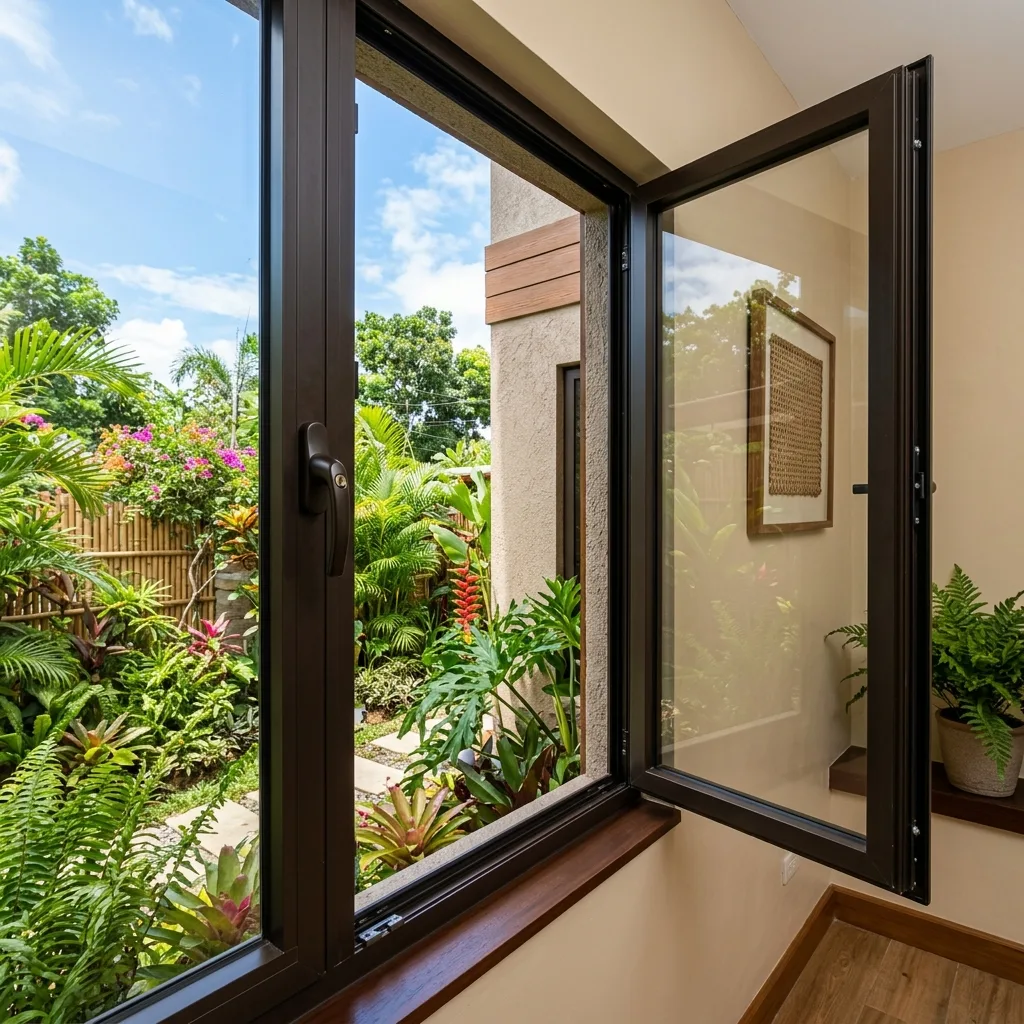
Sliding windows are the default in the Philippines because they are cheap. But when homeowners upgrade their windows, the choice almost always comes down to two superior options: awning windows or casement windows. Both use premium compression gaskets for weather sealing. Both use multi-point locking for security. And most importantly, both swing open to provide 100% of their glass area for ventilation (unlike sliding windows which max out at 50%). So which one is better? The answer depends entirely on the specific room, its exposure to the monsoon, and how you live.
The Engineering Difference: How They Open
Both window types operate using friction stay hinges — specialized stainless steel hardware that holds the window panel open at any angle without slamming shut in a breeze. But where those hinges are mounted changes everything about how the window performs.
Casement windows are hinged on the side (left or right) and swing outward like a door. When fully open, the entire glass panel sits perpendicular to the wall. This allows for maximum, unobstructed lateral airflow. They can be specified to swing left or right depending on your room layout and the prevailing breeze direction.
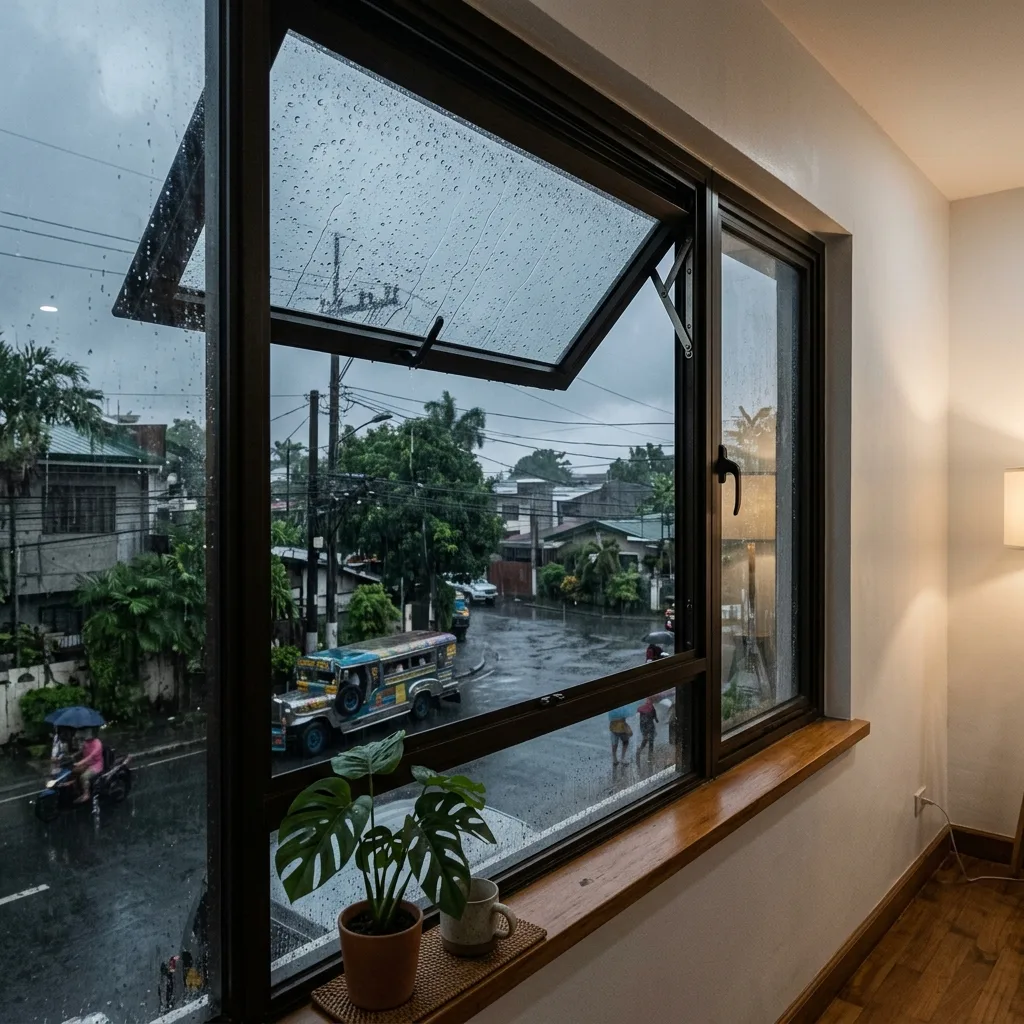
Awning windows are hinged at the top and push outward from the bottom. The glass panel angles outward, creating a canopy or "awning" over the opening. Because the panel must fight gravity, awning windows cannot open to a full 90 degrees — they typically max out at a 45 to 60-degree angle.
| Feature | Casement Window | Awning Window | Winner |
|---|---|---|---|
| Opening Area | 100% (fully unobstructed) | 100% (but angled) | 🏆 Casement |
| Ventilation Volume | Maximum (catches passing breeze) | Moderate (air flows under) | 🏆 Casement |
| Rain Protection | Zero (must close immediately) | Excellent (stays open in rain) | 🏆 Awning |
| Security (Open) | Vulnerable | Difficult to enter | 🏆 Awning |
| Security (Closed) | Excellent (Multi-point lock) | Excellent (Multi-point lock) | Tie |
| Max Height | Up to 1500mm (or 2100mm heavy duty) | Up to 600mm (arm reach limit) | 🏆 Casement |
| Max Width | Up to 600mm (sag risk if wider) | Up to 1200mm | 🏆 Awning |
| Cost | Baseline premium | +10-15% over casement | 🏆 Casement |
Rain Performance: The Philippine Differentiator
In a country that experiences six months of monsoon rains and 20 typhoons a year, how a window handles water is its most important characteristic.
Awning windows are the masters of rain. Because the glass panel angles outward and downward from the top hinge, it physically deflects rainfall away from the opening. You can leave an awning window open 100mm to 150mm during light to moderate rain without a single drop entering your room. This allows continuous fresh air circulation during long rainy days — preventing the stuffy, humid feeling that occurs when a house is sealed tight. Only heavy, wind-driven horizontal rain will breach an open awning window.
Casement windows are highly vulnerable. A fully open casement window exposes the entire window aperture to the sky. At the first sign of drizzle, you must rush to close them. If you leave for work with a casement window open and a sudden afternoon thunderstorm hits, you will return to a flooded floor and ruined furniture. For this reason, casement windows require constant monitoring during the rainy season.
Wind Catching vs Wind Deflecting
When you want maximum cooling breeze, the way the window interacts with passing air matters.
Casement windows act as wind scoops. If you angle the open glass panel toward the prevailing breeze (like the Amihan or Habagat), the glass literally catches the passing air and funnels it directly into the room. This makes casements the undisputed champion of passive cooling. However, a sudden severe wind gust can catch the open panel and damage the friction stays if they are fully extended.
Awning windows deflect wind. The angled panel forces passing air to dive under and up into the room. While it provides good ventilation, it cannot match the sheer volume of air scooped by a casement window.
Size Limitations and Structural Integrity
The laws of physics dictate how large these windows can be built. Ignoring these limits results in sagging panels, broken hinges, and windows that won't close.
| Specification Limit | Casement Window | Awning Window |
|---|---|---|
| Maximum Width | 600mm (standard) | 1200mm |
| Maximum Height | 1500mm (standard) | 600mm |
| Primary Hardware Stress | Sagging (hinge side load) | Gravity (stay arm load) |
| Friction Stay Requirement | Standard duty | Heavy duty |
| Common Failure Mode | Bottom corner drags on frame | Panel won't stay pushed open |
Why casements are narrow and tall: A casement panel acts as a lever pulling against its side hinges. If you make a casement window wider than 600mm, the leverage force becomes too great. Over 2 to 3 years, the glass weight causes the hinges to yield, and the unhinged corner sags, dragging on the bottom frame and preventing the window from closing properly.
Why awnings are wide and short: An awning panel distributes its weight relatively evenly across the top hinges. It can span up to 1200mm wide without issue. However, if you make an awning window too tall (over 600mm to 800mm), the bottom edge extends beyond a human's arm reach, making it impossible to grab the handle to pull the window shut against gravity.
Room-by-Room Recommendations
Because of their distinct characteristics, we strongly recommend assigning the right window type to the right room. Do not force a uniform look at the expense of daily function.
| Room | Best Window Type | Why It Wins |
|---|---|---|
| Bedrooms | Awning | Allows sleeping with fresh air during light rain. You don't have to wake up and rush to close them at 2 AM. |
| Living Rooms | Casement | Maximum cross-ventilation for large spaces. You are usually awake to close them if rain starts. |
| Kitchens | Awning | Placed above counters, they vent cooking odors while keeping rain out. They don't swing out into exterior walkways. |
| Bathrooms | Awning | High wall placement ensures privacy. Can be left cracked open 24/7 for continuous moisture exhaust without rain risk. |
| High-Rise Condos | Awning (limited opening) | Safer against extreme wind loads at high altitudes. Casements act as dangerous sails in high-rise wind tunnels. |
| Stairwell / High transoms | Awning (motorized) | Hot air rises. High awning windows exhaust trapped heat perfectly. Motorization solves the arm-reach problem. |
Cost Comparison and Value (2026 Prices)
Both options are considered premium compared to sliding windows because they require heavy-duty friction stays and multi-point locking mechanisms. However, there is a slight price difference between the two:
| Cost Component | Casement (Per SQM) | Awning (Per SQM) |
|---|---|---|
| Aluminum Frame (Series 79) | ₱4,500 – ₱6,500 | ₱5,000 – ₱7,000 |
| Friction Stays | Standard duty (₱800) | Heavy duty (₱1,200) |
| Multi-point lock | ₱1,200 – ₱2,000 | ₱1,200 – ₱2,000 |
| Installation Labor | ₱500 – ₱800 | ₱500 – ₱800 |
| Total Estimated Cost | ₱7,000 – ₱10,100 / sqm | ₱7,900 – ₱11,000 / sqm |
Why awnings cost slightly more: An awning window requires heavier-duty friction stays because the hardware must constantly fight gravity to hold the glass panel open. A casement window's weight is supported differently, requiring less tension in the stays.
Security and Weather Sealing
When closed and locked, both window types provide identical, exceptional performance.
Weather sealing: Unlike sliding windows which use porous brush strips, both casement and awning windows use EPDM rubber compression gaskets around the entire perimeter. When you turn the handle, the multi-point lock engages and pulls the window sash tight against these rubber gaskets. This creates a near-airtight, watertight seal that absolutely dominates sliding windows during a typhoon.
Security: The same multi-point locking system (typically 2 to 4 locking points depending on window height) makes these windows extremely difficult to pry open from the outside. A sliding window has one central lock; a casement or awning has locks distributed along the frame.
Noise reduction: Because the compression seal is airtight, sound transmission is drastically reduced. Upgrading from standard sliding windows to casement or awning windows (even with standard glass) will noticeably quiet your room.
The Ultimate Solution: Combination Units
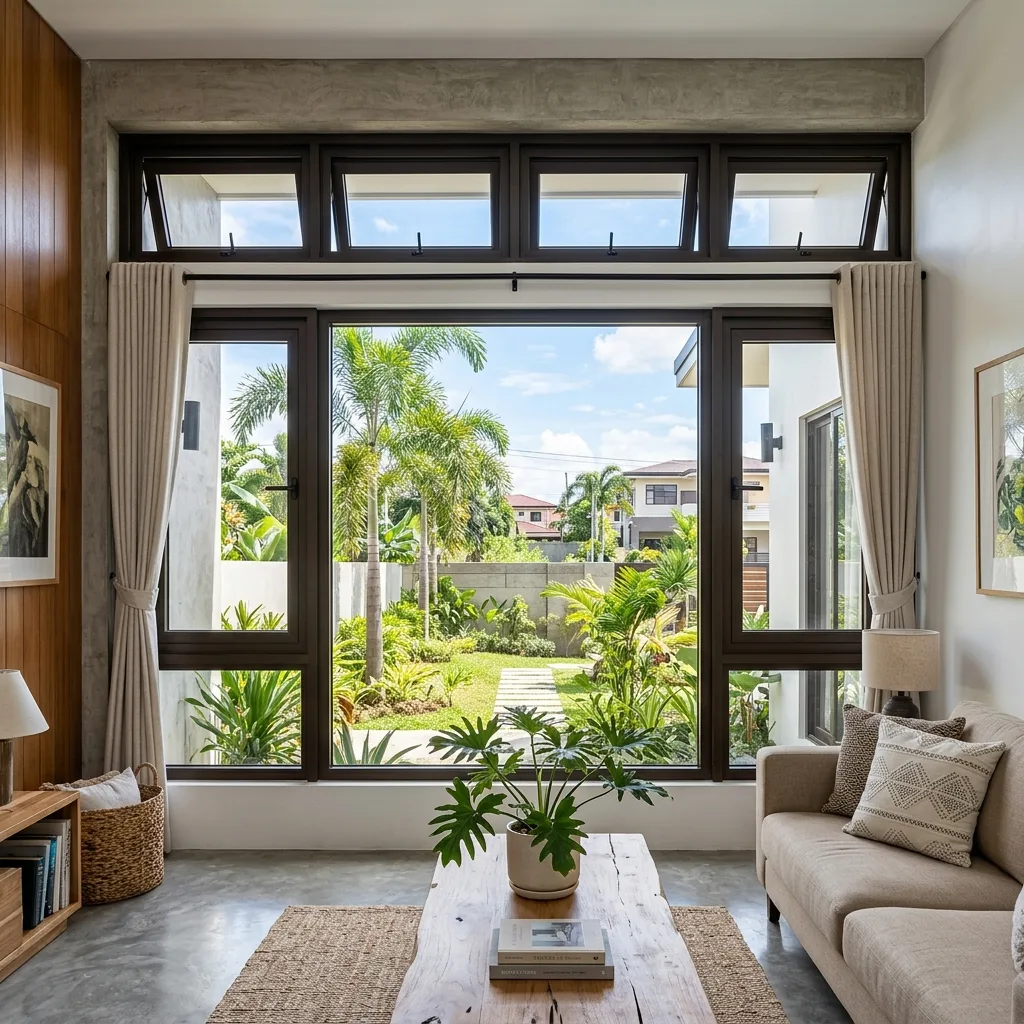
You don't have to choose just one. For large openings in living rooms or dining areas, the best architectural solution is a combination unit built into a single continuous frame. A classic combination features a large fixed picture window in the center for unobstructed views, flanked by two side-swinging casement windows for maximum breeze-catching, with a row of small awning windows mounted high above as transoms. This setup gives you everything: the view, the massive cooling airflow on dry days, and the ability to close the casements but leave the high awnings open to exhaust trapped heat during a rainstorm. It is the perfect window strategy for the Philippine climate.
Ready to Upgrade Your Windows?
Free site visit, design consultation, and an itemized quotation comparing casement and awning options for your specific rooms.